

One of the first instructions people hear when learning to wear kimono is “left over right.” The same convention applies to yukata and many other Japanese wrap-front garments, including traditional-style samue jackets.
The wording can still be confusing. Does “left” mean the wearer’s left or the left side seen by another person? Which panel goes against the body first? Does the rule also apply to open jackets such as haori?
The practical answer is simple:
Place the wearer’s right panel against the body first. Bring the wearer’s left panel over it.
The left side is therefore visible on top when the garment is worn correctly.
Whose Left Side Does the Rule Mean?
“Left over right” is described from the wearer’s perspective.
Your left panel goes over your right panel.
Someone standing in front of you will see the top panel on the opposite side from their own perspective. This is one reason people make mistakes when copying an outfit from a photograph.
To avoid confusion, do not think about what an observer sees. Look down at your own clothing and identify your left hand.
The panel held by your left hand should finish on top.
How to Wrap the Garment Correctly
Use this sequence for a kimono, yukata, or traditional wrap-front samue jacket:
- Put your arms through the sleeves.
- Allow the garment to settle evenly on your shoulders.
- Hold one front panel in each hand.
- Bring the right panel across your body first.
- Place the left panel over the right.
- Adjust the neckline and hem.
- Secure the garment with its ties, cords, or obi.
Another way to remember the order is:
Right side against the body. Left side visible on top.
The direction should be checked before tightening any cords or completing the rest of the outfit.
Why the Direction Matters
In normal Japanese dress, left over right is the established convention.
The reverse arrangement—right over left—is associated with the way deceased people are traditionally dressed. For that reason, it is not used for ordinary kimono or yukata wear.
This difference is why dressing guides emphasize the rule even for informal settings. It is not simply a styling preference that changes with color, gender, or personal taste.
The practical lesson is more important than searching for one simplified origin story: living wearers use left over right.
Does the Rule Apply to Both Men and Women?
Yes.
Men, women, and children normally wear kimono and yukata with the left panel over the right.
The wrap direction does not change according to:
- Gender
- Age
- Formality
- Pattern
- Season
- Whether the garment is new or vintage
Other elements of Japanese dress can vary considerably, but the basic overlap remains the same.
Does the Rule Apply to Kimono?
Yes. A kimono is wrapped left over right before the obi is secured.
The overlap needs to remain stable and provide sufficient coverage. Pulling the panels too tightly can distort the collar and restrict movement, while insufficient overlap can cause the front to open.
During dressing, adjust:
- Garment height
- Front overlap
- Collar position
- Hem alignment
- Movement room
Then secure the garment with the appropriate cords and obi.
The obi does not determine the wrap direction. The panels should already be correctly arranged before the obi is tied.
Does the Rule Apply to Yukata?
Yes. Yukata follows the same left-over-right convention as kimono.
A yukata is generally lighter and simpler to wear, but its front panels are not reversed.
Put the right panel against the body first. Bring the left panel over it and secure the position before adding the obi.
Because yukata fabric may be lightweight, check that the lower front remains overlapped when you walk or sit.
Does the Rule Apply to Samue?
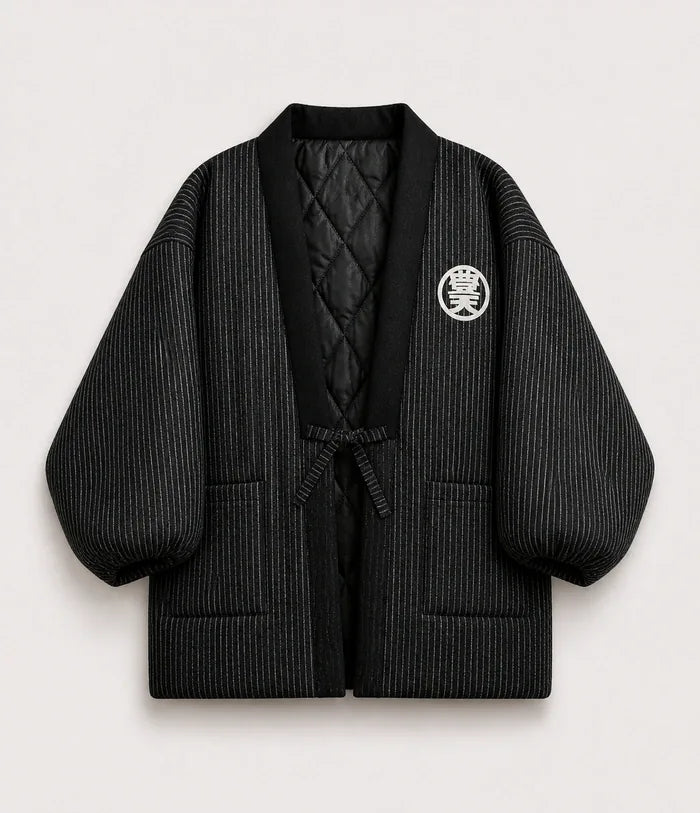
Traditional wrap-front samue jackets normally follow the same direction.
Place the right front panel against the body and bring the left panel over it. Fasten the inner tie first if the jacket includes one, followed by the outer tie.
Check that the jacket:
- Remains overlapped when you sit
- Does not pull across the upper back
- Forms a comfortable V-shaped neckline
- Stays secure without tightly stretched ties
Modern samue-inspired clothing may use modified closures. Follow the garment’s construction when it is clearly designed differently, but do not reverse a conventional wrap front merely for styling.
Does the Rule Apply to Haori?
Not in the same way.
A haori is an outer jacket that normally hangs open. Its front sides do not overlap like those of a kimono.
Some traditional haori use small connecting cords called haori-himo. These cords hold the two sides near each other without placing one complete panel over the other.
A modern haori-style jacket may include ties, buttons, or an overlapping front. If it is designed as a true wrap jacket, its instructions may specify how it closes. A traditional open haori does not require a left-over-right overlap.
Does the Rule Apply to Hanten?
A padded hanten normally has an open front with simple ties. The front edges may meet or remain partly open, but they do not usually create the same full overlap as kimono.
Tie the hanten according to its construction without forcing one side far across the other.
If a garment marketed as hanten has a full wrap front, inspect its design and follow the seller’s instructions. Product names are not always used consistently online.
Does the Rule Apply to Happi Coats?
A happi coat is usually worn open or secured with a belt or sash. Its front does not normally overlap in the same way as kimono.
If the coat has no wrap construction, the left-over-right rule is not relevant to its front edges.
The sash should hold the coat comfortably rather than pulling one side across the body unnecessarily.
Does the Rule Apply to Noragi-Style Jackets?
Noragi is a broad term associated with traditional Japanese work clothing, so construction varies.
Many modern noragi-style jackets use:
- An open front
- Small ties
- A partial overlap
- A complete wrap front
- Buttons or other modern closures
For a clearly traditional wrap construction, use left over right. For an open jacket, no overlap is needed.
Look at how the ties and panels are built instead of making a decision from the product name alone.
Open Front and Wrap Front Are Different
The left-over-right rule applies when one front panel crosses over the other.
It does not mean every Japanese jacket must be pulled across the body.
An open-front jacket may be designed to create two vertical edges. Forcing it closed can:
- Distort the shoulders
- Pull the neckline out of shape
- Stress the ties
- Make the jacket appear too small
- Restrict movement
Before applying the rule, determine whether the garment is actually intended to wrap.
How to Identify the Panels
Lay the garment flat with the front facing upward.
Imagine yourself inside it. The panel attached to the left side of your body is your left panel, even though it may appear on the viewer’s right when displayed.
When wearing the garment:
- Hold the right panel with your right hand
- Move it across the body
- Hold it in place
- Bring the left panel over it
- Secure the ties
If the garment has inner and outer ties, their positions usually support this order.
A Simple Memory Method
Use the phrase:
“Left is last.”
The right panel crosses first. The left panel crosses last and remains visible.
Another memory method is to place your left hand flat against the outer panel after dressing. If your left hand is touching the panel that sits on top, the direction is correct.
Choose one method and use it consistently.
Check Before Adding the Obi
For kimono or yukata, pause before tying the obi.
Confirm:
- The left panel is on top
- The neckline is even
- The lower front provides coverage
- The hem is correctly positioned
- The garment is comfortable enough for walking and sitting
Correcting the direction after completing the obi requires much more work than checking beforehand.
Check the Direction While Wearing Samue
For samue, the jacket ties make correction easier, but it is still best to check before leaving home.
Look down at the neckline. Follow the outer edge with your hand and confirm that it belongs to your left panel.
When putting on a Seapoom samue, fasten the right panel against the body first and place the left panel over it unless that specific product is constructed with a clearly different modern closure.
Be Careful with Mirrors
A normal mirror shows a reflected version of your appearance. This can make the overlap look opposite to what another person sees.
Do not decide by asking which side appears left in the mirror.
Instead:
- Identify your actual left hand.
- Touch the outer panel.
- Confirm that the top panel belongs to your left side.
Your body remains the reference, not the reflected image.
Be Careful with Selfie Cameras
Some phones save selfies as mirrored images. Others show a mirrored preview but save the final photograph in a different orientation.
This means a correctly worn garment can appear reversed in one image.
Before assuming the outfit is wrong, check:
- Whether text in the image is reversed
- Which hand was actually holding an object
- Whether the phone mirrored the saved photograph
- The garment itself rather than the screen
For an instructional image, use a rear camera or disable mirrored selfie saving when possible.
Be Careful When Copying Online Photos
A photograph may have been:
- Mirrored by the camera
- Flipped during editing
- Taken through a mirror
- Uploaded incorrectly
- Styled with a modern nontraditional closure
Do not use a single image as the only dressing instruction.
Learn the physical sequence instead: right panel in, left panel over.
Dressing a Mannequin or Display Form
The rule remains based on the garment’s wearer, even when no person is inside it.
Stand behind the mannequin as if you were wearing the garment, or identify its right and left sides before wrapping.
Place the mannequin’s right panel against the body and its left panel over it.
This is especially important for product photography because an incorrect display can confuse customers who use the image as a reference.
Front-Facing Product Photography
When a correctly dressed model faces the camera, the visible outer panel may appear on the right side of the photograph from the viewer’s perspective.
That does not mean the model is wearing it right over left. The viewer and wearer face opposite directions.
Product descriptions can reduce confusion by stating “the wearer’s left panel goes over the right.”
What If the Garment Has Buttons or Snaps?
A modern Japanese-inspired garment may use buttons, snaps, or a zipper instead of a traditional wrap closure.
Use the closure as designed.
The left-over-right convention should not be applied mechanically to a jacket that does not overlap or that uses a fixed modern fastening system.
Accurate terminology helps here. A kimono-inspired cardigan is not automatically governed by every rule of formal kimono dressing.
What If the Ties Seem to Favor the Opposite Side?
First confirm that you have identified the inner and outer ties correctly.
A samue jacket may include:
- A hidden inner tie
- An outer side tie
- Ties at slightly different heights
- A closure that is difficult to see when the garment is new
Do not twist the jacket or stretch the ties across the body.
If the construction genuinely closes in another direction, it may be a modern wrap design rather than a traditional samue closure. Follow the product instructions and avoid describing it as conventional kimono dressing.
Correct Direction Does Not Guarantee Correct Fit
A garment can be wrapped left over right and still fit poorly.
Check for:
- Enough front overlap
- Comfortable chest room
- Upper-back movement
- A stable neckline
- Correct garment length
- Secure ties
- Adequate hip coverage
If the front will not remain closed without tension, the issue may be size rather than dressing technique.
Avoid Pulling the Wrap Too Tightly
The overlap should provide coverage without restricting breathing or movement.
An excessively tight wrap can:
- Pull the neckline against the throat
- Limit shoulder movement
- Distort the garment
- Create stress at the ties
- Make sitting uncomfortable
Wrap the panels smoothly and allow the garment’s intended ease to remain.
Check the Lower Overlap
For full-length kimono and yukata, the overlap below the waist matters as much as the neckline.
Walk a few steps and sit carefully. The lower front should maintain appropriate coverage without restricting stride.
A samue jacket is shorter, but its hem should also remain reasonably overlapped during movement.
If the lower panel opens repeatedly, check the garment width and tie adjustment.
Teach the Rule Clearly
When helping someone else dress, avoid saying only “this side goes over that side.”
Instead, say:
“Your right panel goes against your body first. Your left panel goes on top.”
Ask the wearer to touch their left hand to the outer panel. This reduces confusion caused by facing each other.
Correcting the Direction
If you notice the mistake before securing the garment:
- Open both panels.
- Place the right panel against the body.
- Bring the left panel over it.
- Readjust the neckline and hem.
- Refasten the ties or cords.
If a kimono or yukata is already secured with an obi, remove or loosen the obi rather than trying to pull the panels through beneath it.
Taking a few minutes to dress again is better than creating twisted fabric and uncomfortable tension.
Wear the Rule Without Anxiety
People learning to wear Japanese clothing sometimes become so concerned about the overlap that they cannot enjoy the garment.
The convention is important, but the physical action is straightforward. After repeating the same sequence several times, it becomes automatic.
Remember:
- Wearer’s perspective
- Right panel first
- Left panel last
- Left remains on top
Then focus on fit, movement, and the occasion.
Common Mistakes
Using the viewer’s perspective
The rule refers to the wearer’s left and right, not the observer’s.
Copying a mirrored selfie
Phone images may reverse the outfit.
Applying the rule to an open haori
An open jacket does not need to overlap.
Reversing the panels for symmetry
Pattern placement does not change the conventional direction.
Tightening the ties to correct insufficient overlap
A garment that is too small needs a different size or adjustment, not more tension.
Assuming the rule changes for men
Men and women use the same left-over-right direction.
A Final Dressing Check
Before leaving home, confirm:
- My right panel is against my body.
- My left panel is visible on top.
- The neckline feels comfortable.
- The front remains secure when I move.
- The ties are not under excessive tension.
- My photograph is not misleading me through mirroring.
- My garment is actually designed to wrap.
This check takes only a few seconds.
Final Thoughts
Kimono, yukata, and conventional samue jackets are worn with the wearer’s left panel over the right. The easiest sequence is to place the right panel against the body first and bring the left panel over it.
The rule does not require every Japanese jacket to overlap. Traditional haori, padded hanten, happi coats, and many modern noragi-style jackets may hang open or use different closures.
Identify the garment type, follow its construction, and remember that left and right always refer to the person wearing it.
Frequently Asked Questions
Which side goes on top when wearing kimono or yukata?
The wearer’s left panel goes on top of the right panel. Put the right panel against your body first, then bring the left panel over it before securing the garment.
Does a haori need to be worn left over right?
No. A traditional haori normally hangs open or connects with small cords, so its front panels do not overlap like kimono. Do not force an open haori to wrap across the body.
Why does my correctly wrapped garment look reversed in a selfie?
Many phones mirror the camera preview or saved selfie. Check the physical garment by touching the outer panel with your left hand. If that panel belongs to your left side, the wrap direction is correct.

Leave a comment
This site is protected by hCaptcha and the hCaptcha Privacy Policy and Terms of Service apply.