

Two Japanese-style jackets can have nearly identical shapes and feel completely different when worn. One may be light and soft enough for a warm room, while another holds its shape like a work jacket. A third may include padding for winter even though its outer fabric is also cotton.
The difference comes from more than the fiber name on the label.
Fabric weight, weave, finishing, lining, padding, and garment construction all influence breathability, warmth, texture, drape, durability, and care. “100% cotton” does not automatically mean lightweight, and “polyester” does not describe one universal type of fabric.
Understanding these details helps you choose a haori, hanten, noragi-style jacket, or samue set that suits how and where you plan to wear it.
Fiber and Fabric Are Not the Same Thing
A fiber is the material used to make yarn. Cotton, linen, and polyester are fibers.
A fabric is created by weaving, knitting, or otherwise forming those yarns into a surface. Denim, for example, is a type of woven fabric traditionally made mainly from cotton. It is not a separate natural fiber.
This distinction explains why two cotton garments can perform differently. Lightweight cotton gauze, smooth poplin, textured woven cotton, denim, and heavy canvas may all contain cotton, but their thickness and structure are not the same.
When evaluating clothing, consider:
- Fiber composition
- Fabric weight
- Weave or knit
- Surface texture
- Lining
- Padding
- Washing treatment
- Garment construction
The fiber label is a useful starting point, not a complete description.
Cotton
Cotton is common in Japanese-inspired clothing because it can be made into light, medium, or heavy fabrics. It is used for samue, haori-style jackets, noragi-inspired workwear, yukata, and the outer shells or linings of padded hanten.
How cotton feels
Cotton generally feels familiar against the skin and becomes softer with wear and washing. Its exact texture depends on the yarn and weave.
A fine, smooth cotton can feel light and flexible. A thick woven cotton may feel firm or slightly rough when new. Textured fabrics can create a more substantial surface without needing printed decoration.
Is cotton breathable?
Cotton can be breathable, but weight and weave matter.
A loose, lightweight cotton allows more air to pass through than dense canvas or heavy denim. An oversized jacket made from thick cotton can feel warmer than a closer-fitting jacket made from a lighter weave.
For warm weather, look for:
- Lightweight fabric
- An open or relatively loose weave
- An unlined construction
- A relaxed but not excessively bulky fit
For cooler conditions, a denser cotton provides more coverage but still may not block wind effectively.
Moisture and drying
Cotton absorbs moisture. This can feel comfortable when the fabric takes perspiration away from the skin, but saturated cotton becomes heavier and dries more slowly than many synthetic materials.
A cotton jacket is not automatically suitable for rain. If it becomes thoroughly wet, it may take considerable time to dry, particularly when lined or padded.
Wrinkling
Cotton wrinkles according to its weave and finish. Thin fabric may crease easily, while heavy textured cotton can hide smaller wrinkles.
Wrinkles do not necessarily indicate poor quality. They are a normal characteristic of many natural-fiber garments.
Shrinkage
Cotton can shrink when exposed to hot water or high dryer temperatures. The amount depends on how the fabric was prepared before the garment was made.
Do not assume that every cotton garment has been preshrunk. Follow the care label rather than choosing a larger size based on an estimated shrinkage amount.
Best uses for cotton
Cotton works well when you want:
- Everyday comfort
- A natural surface texture
- A range of seasonal weights
- Fabric that softens with wear
- A casual appearance
- A washable garment, when permitted by the care label
Linen
Linen is made from flax fibers. It is known for its dry texture, airflow, and visible natural character.
Pure linen and cotton-linen blends are frequently used in relaxed summer clothing and lightweight Japanese-inspired jackets.
How linen feels
New linen can feel crisp or firm. It generally softens through wear and washing.
The surface may include small variations in yarn thickness. These irregularities can be part of the fabric’s character rather than damage.
Very rough areas, broken yarns, or open seams should still be examined separately from normal linen texture.
Linen in warm weather
Linen is often selected for hot conditions because it allows airflow and does not usually cling heavily to the body.
However, a thick linen fabric or lined linen jacket may still feel warm. As with cotton, the weave and garment construction remain important.
A lightweight, unlined linen or cotton-linen haori-style jacket is generally more suitable for heat than a dense, multilayered version.
Wrinkling
Linen wrinkles easily. Its creases tend to be visible and are often accepted as part of a relaxed appearance.
If you prefer a consistently smooth surface, linen may require more steaming or pressing than you want. A cotton-linen blend may wrinkle less sharply, although the result depends on the blend ratio and weave.
Strength and care
Linen can be durable, but it should not be treated carelessly. Repeated sharp folds in the same place can create stress, and high heat may affect the garment.
Reshape linen clothing before air drying. Follow the care label when ironing or steaming, particularly if the garment contains a lining, interfacing, or synthetic blend.
Best uses for linen
Linen is useful when you want:
- Warm-weather comfort
- A dry, textured hand feel
- A relaxed, naturally wrinkled appearance
- Lightweight layering
- Fabric that softens with use
Cotton-Linen Blends
Cotton-linen blends combine characteristics of both fibers.
Cotton may add softness and familiarity, while linen can contribute texture and airflow. A blend can be easier to handle than pure linen, but its performance depends on the percentage of each fiber and the fabric construction.
One cotton-linen jacket may be light and flowing. Another may use a dense weave that feels closer to structured workwear.
Check:
- Fiber percentages
- Fabric weight
- Whether the garment is lined
- Surface texture
- Washing instructions
Do not assume that every cotton-linen blend is a summer fabric.
Denim
Denim is a durable twill fabric most commonly associated with jeans. Many denim fabrics are primarily cotton, although stretch or performance versions may include polyester, elastane, or other fibers.
Denim gives noragi-style and haori-inspired jackets more structure than lightweight cotton.
Fabric weight
Denim ranges from light shirting weights to heavy workwear fabrics.
Light denim can drape relatively easily and work as an overshirt. Heavy denim holds its shape, adds warmth, and may feel stiff before it is broken in.
Product photographs do not always communicate this difference. Look for a fabric-weight description or close-up images of the texture.
Indigo and fading
Traditional-looking denim is often dyed in shades associated with indigo. Dark dye may transfer onto:
- Light shirts
- Pale furniture
- Bags
- Shoes
- Car seats
- Other clothing
Transfer is more likely when the fabric is new, damp, or exposed to friction.
Denim also changes with wear. Fading may develop around seams, pockets, cuffs, ties, and elbows. Some wearers appreciate this change, while others prefer a more consistent color.
Washing denim
Frequent washing can accelerate fading, but avoiding washing indefinitely is not always practical. Dirt, odor, and hygiene should guide your routine.
When the care label allows washing:
- Wash dark denim separately
- Use cool water
- Turn the garment inside out when appropriate
- Avoid bleach
- Reshape before air drying
- Keep wet denim away from pale surfaces
If the jacket combines denim with another fabric, follow the care needs of the most delicate component.
Best uses for denim
Denim is suitable when you want:
- A structured silhouette
- Workwear character
- Durable-feeling fabric
- Visible aging and fading
- A medium or heavier outer layer
- Pockets that can support everyday items
It may be less suitable for hot, humid weather or lightweight travel.
Polyester
Polyester is a synthetic fiber used in outer fabrics, linings, insulation, and blends.
It is sometimes dismissed simply because it is synthetic, but its performance depends greatly on yarn construction, weave, finish, and garment design.
Wrinkle resistance
Polyester often resists wrinkling better than untreated cotton or linen. This can be useful for travel, frequent wear, and garments that need to maintain a consistent shape.
However, sharp creases caused by excessive heat can be difficult to remove.
Drying speed
Polyester generally absorbs less water than cotton and often dries more quickly.
A quick-drying garment can be practical for travel or humid climates, but drying speed does not make the fabric waterproof.
Breathability
Polyester is not automatically unbreathable. Lightweight woven polyester can allow airflow, while dense fabric may trap heat.
Moisture-management finishes can change performance, but these features should be stated by the manufacturer rather than assumed.
Compare the fabric weight, weave, lining, and intended season.
Heat sensitivity
Polyester can be sensitive to high heat from irons, dryers, and other sources. Excessive temperature may create shine, deformation, or permanent damage.
Use the heat setting stated on the care label.
Static and pilling
Some polyester fabrics develop static, particularly in dry conditions. Friction can also create pilling on lower-quality or loosely constructed surfaces.
These issues depend on the specific fabric rather than the fiber name alone.
Best uses for polyester
Polyester can be useful when you want:
- Faster drying
- Reduced wrinkling
- Consistent color
- A smooth lining
- Lightweight insulation
- Easier travel care
Cotton-Polyester Blends
A cotton-polyester blend may combine cotton’s familiar feel with polyester’s wrinkle resistance and quicker drying.
The balance changes according to the percentages. A cotton-rich blend may feel closer to natural cotton, while a polyester-rich blend may dry faster and hold its shape more consistently.
Blends are often practical for clothing that needs regular washing. However, check the care label because high heat can still affect both the fabric and any internal components.
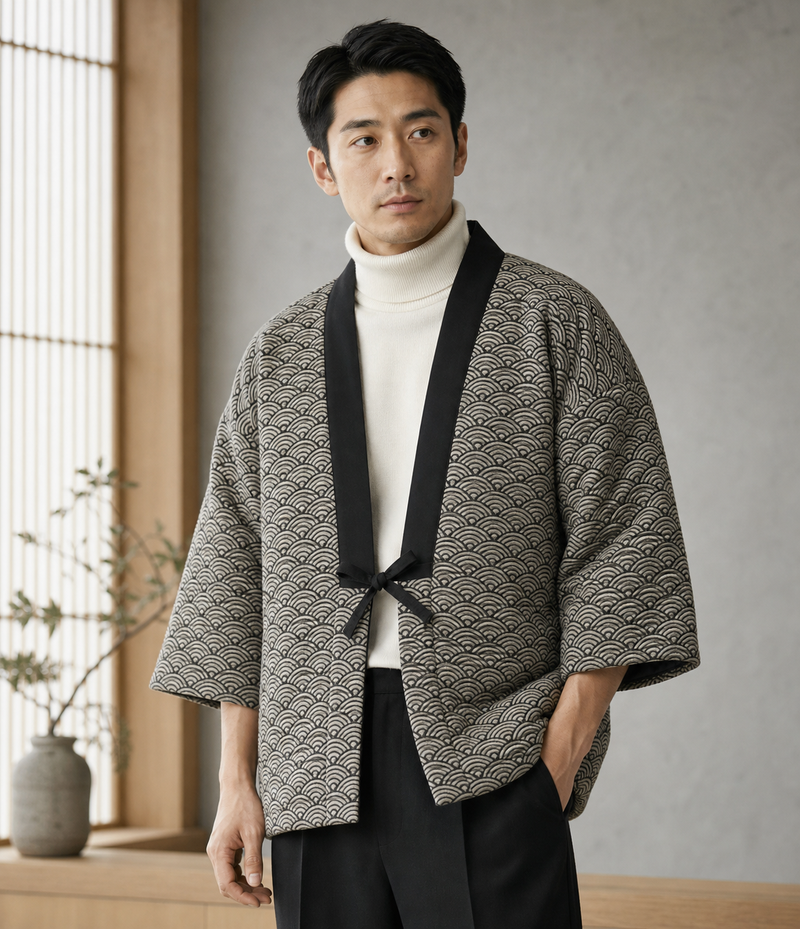
Fabric for Haori-Style Jackets
A haori-style jacket can use many fabrics because it functions primarily as an outer layer.
Choose lightweight cotton, linen, or a cotton-linen blend for warm or mild weather.
Choose medium-weight cotton when you want an adaptable everyday layer.
Choose denim or dense woven fabric when you prefer a structured, workwear-influenced silhouette.
Choose polyester or a blend when wrinkle resistance and quick drying are important.
Traditional silk haori require a different level of care and should not be cleaned according to general cotton-jacket instructions.
Fabric for Noragi-Style Jackets
Noragi-inspired jackets often emphasize practical texture and durability.
Common choices include:
- Medium-weight cotton
- Canvas
- Denim
- Textured woven cotton
- Cotton-linen blends
- Patchwork fabric
Patchwork garments deserve additional inspection. Different panels may shrink, fade, or wear differently.
A patchwork appearance also does not automatically mean the fabric is recycled, vintage, boro, or hand stitched. These details should be stated separately.
Fabric for Samue Sets
Samue must support both upper-body and lower-body movement.
Light cotton or cotton-linen blends work well for warm conditions. Medium-weight cotton offers more structure for everyday wear. Dense woven cotton can suit cooler weather or practical work.
Consider how the fabric feels behind the knees, at the waistband, and beneath the jacket ties. A texture that feels attractive on an outer jacket may feel less comfortable during long periods of sitting.
Wash the jacket and trousers together when appropriate so the two pieces fade and soften at a similar rate.
Fabric for Padded Hanten
A hanten uses several material layers:
- Outer shell
- Insulation
- Inner lining
The outer fabric alone does not determine warmth.
A cotton shell may be combined with polyester insulation. A polyester lining may help the jacket slide over knitwear. Another hanten may use different cotton blends inside and outside.
Check the filling material, thickness, garment weight, and sleeve openings in addition to the outer-fabric label.
Why Fabric Weight Matters
Fabric weight influences how the garment hangs and performs.
Lightweight fabric
Usually offers easier movement and packing but provides limited structure and warmth.
It may also show the outline of pockets or clothing underneath.
Medium-weight fabric
Often provides a balance between drape, durability, and seasonal flexibility.
This is a practical choice for many everyday jackets and samue sets.
Heavyweight fabric
Holds its shape and may feel warmer, but it takes longer to dry and adds bulk during travel.
Heavyweight fabric can also restrict movement if the garment does not provide sufficient room.
If a store does not list a numerical fabric weight, look for descriptions such as lightweight, medium weight, canvas, padded, or suitable for a particular season.
The Effect of Weave and Texture
Weave changes airflow, strength, appearance, and hand feel.
A loosely woven fabric may feel breathable but catch more easily. A tight weave can feel smooth and durable while allowing less airflow.
Textured cotton may be described as slub, dobby, seersucker, waffle, or sashiko-style. These terms do not all describe the same construction.
In particular, a machine-woven surface inspired by sashiko should not automatically be presented as hand-stitched sashiko. Examine the product description to understand whether the term refers to appearance, weave, or actual stitching.
Lining and Reversible Construction
A lining can make a jacket easier to put on, hide internal seams, and add warmth. It also adds weight and may reduce airflow.
Check whether the garment is:
- Unlined
- Partially lined
- Fully lined
- Padded
- Reversible
A reversible jacket effectively has two visible outer surfaces. Examine the fabric composition and care instructions for both sides.
Reversible construction may provide more styling options, but it can also make the garment warmer than a single-layer jacket.
How to Evaluate Fabric Online
You cannot touch fabric through a screen, so use all available product information.
Look for:
- Complete fiber percentages
- Fabric-weight description
- Lining composition
- Padding or filling material
- Close-up texture photographs
- Images showing how the fabric hangs
- Washing instructions
- Shrinkage guidance
- Color-transfer warnings
- Model photographs in natural poses
A close-up image explains texture, while a full-body photograph shows drape. Both are necessary.
When evaluating a Seapoom garment, check the individual product’s material description rather than assuming every haori, hanten, or samue uses the same fabric construction.
Common Fabric Misconceptions
“Natural fabric is always breathable”
Not necessarily. A heavy, tightly woven natural fabric can feel warmer than a lightweight synthetic weave.
“Polyester always feels inexpensive”
Polyester fabrics vary significantly. Yarn, weave, finish, lining, and construction influence the result.
“Cotton is always easy to wash”
Some cotton garments contain delicate dyes, structured layers, padding, or details that require careful cleaning.
“Denim is a separate fiber”
Denim is a fabric construction, usually made mainly from cotton, rather than a fiber category like cotton or polyester.
“Linen should remain perfectly smooth”
Visible wrinkles are a normal feature of linen and part of its relaxed appearance.
“Thicker fabric always lasts longer”
Durability also depends on yarn strength, weave, seam construction, abrasion, washing, and how the garment is used.
Choosing the Right Fabric
Choose lightweight cotton when you want a familiar, breathable layer for warm or mild conditions.
Choose linen or a cotton-linen blend when you value airflow, natural texture, and do not mind wrinkles.
Choose medium-weight cotton when you need a versatile fabric for regular wear.
Choose denim when you want structure, workwear character, and gradual fading.
Choose polyester or a blend when quick drying and wrinkle resistance are priorities.
Choose padded construction when warmth matters more than packability or airflow.
The best material is not universal. It is the one whose texture, weight, maintenance, and performance match your routine.
General Care Principles
Always follow the garment’s care label.
Useful general precautions include:
- Separate dark and light colors
- Use cool water when recommended
- Avoid bleach unless permitted
- Secure long ties before washing
- Use a laundry bag for delicate construction
- Do not overload the washing machine
- Reshape garments before drying
- Avoid high heat unless allowed
- Make sure padded items dry completely
- Test uncertain ironing temperatures on a hidden area
Do not apply one cleaning method to every garment described as haori, hanten, noragi, or samue. The fabric and construction determine the correct care.
Final Thoughts
Fiber names are only the beginning of a useful fabric comparison.
Cotton can be light or heavy. Linen can be airy or structured. Denim is usually cotton but behaves differently because of its weave and weight. Polyester can create a smooth lining, quick-drying outer layer, or lightweight insulation.
Before buying Japanese-inspired clothing, consider fabric composition together with weight, weave, lining, padding, fit, and care. These details provide a more accurate picture of comfort and performance than broad labels such as natural, synthetic, summer, or traditional.
Frequently Asked Questions
Is cotton always more breathable than polyester?
No. Breathability depends on fabric weight, weave, finishing, lining, and garment construction. Lightweight woven polyester may feel cooler than heavy cotton canvas, while light cotton may feel more breathable than dense synthetic fabric.
Which fabric is best for Japanese-style clothing in summer?
Lightweight linen, cotton, and cotton-linen blends are practical options. Look for an unlined construction and a weave that allows airflow. Fabric weight is as important as the fiber name.
Which fabric is easiest to care for?
Polyester and cotton-polyester blends often resist wrinkles and dry quickly, but care still depends on the garment’s construction. Padding, lining, dye, patchwork, and decorative details may require gentler cleaning, so always follow the attached care label.

Leave a comment
This site is protected by hCaptcha and the hCaptcha Privacy Policy and Terms of Service apply.