

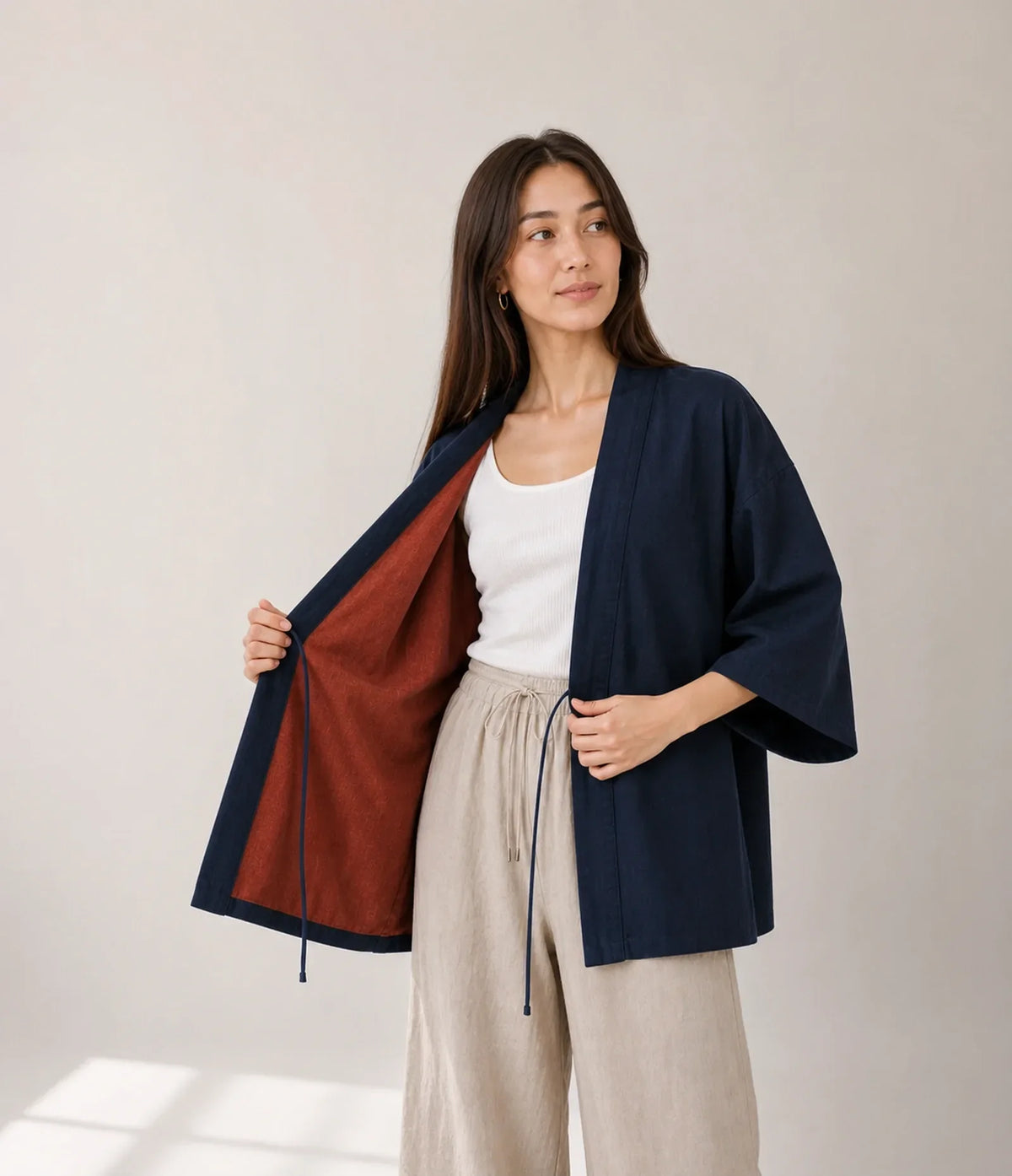
A padded hanten is designed to provide warmth without the close, structured fit of a tailored coat. Its straight body, wide sleeves, and simple front ties should allow comfortable movement over everyday clothing.
That relaxed construction can make sizing appear easy, especially when a product is labeled unisex or one size. However, the padding, open neckline, fixed sleeve reach, and limited front closure all affect how the jacket fits.
A hanten that is too small may compress its insulation and pull across the back. One that is much too large may slip at the shoulders and allow warm air to escape through the neckline and sleeves.
Before ordering, compare the finished garment measurements with a jacket you already wear comfortably. Pay particular attention to body width, upper-back room, sleeve reach, jacket length, and the layers you plan to wear underneath.
Decide Where You Will Wear the Hanten
The right fit depends on the jacket’s intended use.
A hanten worn over pajamas at home needs less layering room than one worn over a sweatshirt in a cold workshop. A jacket used mainly while sitting may need more room through the hips and abdomen than one worn for short periods while standing.
Consider whether you will use it:
- Over light homewear
- Over a samue set
- Over a shirt and sweater
- While working at a desk
- During household tasks
- For short outdoor errands
- While traveling
- In a cool studio or workshop
Measure yourself and your reference jacket while wearing the thickest layer you expect to use regularly.
Understand Body and Garment Measurements
A body measurement describes the wearer. A garment measurement describes the finished jacket.
A padded hanten must be larger than the body so it can contain both the wearer and the layers underneath. The difference between the two measurements is often called ease.
There is no single correct amount of ease for every hanten. The ideal amount depends on:
- Padding thickness
- Fabric stiffness
- Number of layers underneath
- Shoulder shape
- Intended activity
- Personal fit preference
Do not compare a body circumference directly with a flat garment width without confirming how the size chart is written.
If the jacket measures 60 cm across when laid flat, its approximate circumference may be 120 cm. This calculation is only useful if the measurement includes the complete jacket width and the seller measures straight across comparable points.
Start with a Reference Jacket
Choose a relaxed jacket or coat that already fits you well over similar clothing.
A fitted blazer is not an ideal reference because its shoulders, armholes, and closure work differently. A bulky technical coat may provide more room than you want indoors.
Lay the reference jacket flat without stretching it and record:
- Chest or body width
- Shoulder width
- Sleeve reach
- Jacket length
- Hem width
- Upper-arm width, if available
- Sleeve opening
Then try it on over your intended base layers. Note where you would prefer more or less room.
Measure Your Body
Use a flexible tape measure over the clothing you expect to wear under the hanten.
Record:
- Chest or bust circumference
- Waist circumference
- Hip circumference if the jacket will cover the hips
- Shoulder and arm reach
- Upper-arm circumference
- Preferred jacket length
Keep the tape level and comfortably close to the body without pulling it tight.
Height and weight can help describe general proportions, but they cannot predict hanten fit on their own. People with the same height may have different torso lengths, shoulder widths, arm lengths, and layering preferences.
How to Measure a Hanten Laid Flat
Place the jacket on a flat surface with the front facing upward. Smooth large wrinkles gently without compressing or stretching the padding.
Body width
Measure horizontally across the jacket near underarm level.
Because a hanten may not have a conventional armhole seam, follow the measuring points shown by the seller. One store may provide the full flat width, while another may list only the width of a back panel.
The body width needs to accommodate your chest, upper back, clothing layers, and insulation.
Shoulder width
If the hanten has clear shoulder seams, measure across the back from one seam to the other.
Many hanten use dropped or straight shoulders. The seam may sit beyond your natural shoulder point, so shoulder width should be considered together with sleeve reach.
Sleeve length or reach
A modern size chart may measure from the shoulder seam to the cuff. Another chart may measure from the center back of the neck to the sleeve end.
These are different measurements. Always check the diagram before comparing them.
For a dropped-shoulder hanten, the complete center-back-to-cuff measurement often gives a more useful picture of where the sleeve will finish.
Jacket length
Measure from the collar or shoulder point specified by the seller straight down to the hem.
A short hanten may finish around the upper hip. A longer style can cover more of the seat and upper legs.
Hem width
Measure straight across the bottom of the jacket.
Hem width matters when the hanten reaches the hips or when you plan to wear it while sitting. A roomy chest does not guarantee enough room lower down.
Upper-arm width
Measure across the sleeve near its widest upper section.
This measurement is important if you have muscular arms or intend to wear thick knitwear underneath. A wide body with narrow upper sleeves can still feel restrictive.
Sleeve opening
Measure across the cuff or sleeve opening.
A wide opening makes movement easier but allows more warm air to escape. A smaller opening retains warmth more effectively but must still accommodate your wrist and base layers comfortably.
How Should the Chest and Back Fit?
A padded hanten should not sit tightly across the chest.
The front ties are designed to hold the sides closer together, not pull a small jacket around the body. Depending on the design, the front edges may remain partly open even when tied.
Check upper-back movement by reaching both arms forward. The jacket should not pull sharply across the shoulder blades.
If horizontal tension lines appear across the back or the front sides move far apart when you reach, the body or upper back may be too narrow.
The padding should retain its loft rather than being pressed flat against the body.
How Should the Shoulders Fit?
Hanten shoulders usually look softer and less defined than those of a blazer.
A dropped shoulder is common and can be part of the intended silhouette. The seam does not need to sit exactly on your shoulder point.
However, the jacket may be too large if:
- It continually slides backward
- The neckline moves away from the body
- The cuffs cover the hands excessively
- The upper body twists during normal movement
- The weight feels unsupported
The jacket may be too small if:
- The shoulders feel tight when reaching
- The fabric pulls across the upper back
- The sleeves rise significantly when you move
- The neckline spreads apart under tension
Judge the shoulder together with the complete sleeve reach and upper-back fit.
Where Should the Sleeves End?
Traditional-style hanten sleeves may finish above the wrist. This shorter length can be practical for cooking, cleaning, writing, crafts, and other tasks involving the hands.
A sleeve that does not reach the wrist is not automatically too short.
Choose the sleeve position according to your use:
- Above the wrist for household or practical work
- Near the wrist for greater warmth
- Slightly longer for relaxed casual styling
The sleeves should not cover so much of the hands that they interfere with grip or movement.
If you have long arms, check the center-back-to-cuff measurement rather than relying on the model photograph.
Choosing the Right Jacket Length
Hanten length affects warmth, movement, and how the jacket feels while sitting.
Shorter hanten
A shorter style provides easier movement around the hips. It can be comfortable for household tasks and active work.
However, it covers less of the lower torso and may allow more cold air to enter around the hem.
Longer hanten
A longer jacket provides more coverage over the hips and upper legs. It may feel warmer while standing or walking.
When sitting, a long hem can bunch beneath the body or push the jacket upward. Check the hem width and try sitting in a reference jacket of similar length.
Allow Room for Layers
Decide what will be worn underneath before choosing a size.
For light indoor use, the base may include:
- A T-shirt
- A long-sleeve cotton shirt
- Light pajamas
- A samue jacket
For colder conditions, you may add:
- A thermal base layer
- A sweatshirt
- A medium-weight knit
- Heavier trousers
Wear these layers while measuring your reference jacket.
More room is not always warmer. If the hanten is excessively large, warm air can escape more easily through the neckline, front, sleeves, and hem. Aim for comfortable space without uncontrolled gaps.
Padding Changes the Fit
A padded jacket occupies more space than an unlined jacket with the same external measurements.
Thicker insulation can make the interior feel smaller, particularly around:
- The upper arms
- The shoulders
- The neckline
- The side seams
It can also make the jacket appear shorter or wider when worn.
Do not assume that measurements from an unlined haori will produce the same fit in a padded hanten. Use a lightly insulated jacket as your reference when possible.
Consider the Weight of the Jacket
A heavily padded hanten may pull differently on the shoulders than a lightweight version.
If the jacket is oversized as well as heavy, it may shift during movement. A balanced fit allows the weight to rest across the shoulders and upper back without pressure at one point.
Product photographs do not always communicate weight accurately. Check the listed garment weight or fabric description where available.
Check the Front Ties
The ties should meet without strain and sit in a comfortable position on the torso.
When tied:
- The neckline should remain comfortable
- The front should not twist
- The sides should not pull sharply inward
- The ties should not press into the body
- The jacket should remain easy to remove
Do not use the ties to force the front of a small jacket closed. Doing so can damage the attachment points and compress the insulation.
Long ties should be kept away from open flames, tools, and machinery.
Hanten Fit While Sitting
A jacket can feel comfortable while standing and restrictive while sitting.
Sit in a chair and check:
- Whether the hem pushes the jacket upward
- Whether the front ties press into the abdomen
- Whether the back pulls across the shoulders
- Whether the neckline shifts
- Whether the sleeves remain practical
- Whether pockets become difficult to reach
If you plan to wear the hanten at a desk or during long periods of sitting, this test is as important as the standing fit.
Fit Considerations for Different Body Shapes
Broad shoulders
Prioritize upper-back and upper-arm room. A wide chest measurement does not guarantee that these areas will feel comfortable.
Full chest or bust
Check that the front hangs naturally without the ties being pulled under tension. The jacket does not need to close completely, but it should sit securely on the shoulders.
Full hips
If the jacket reaches the widest part of your hips, compare the hem width as well as the chest width.
Long arms
Use the full center-back-to-cuff measurement when possible. A general height recommendation may not account for your reach.
Short torso or petite frame
A wide unisex size may fit through the body but feel too long in the sleeves or hem. Compare every dimension rather than choosing based only on chest room.
Tall frame
Check both jacket and sleeve length. Sizing up for length can also add unnecessary width, so look for a design with suitable proportions.
What Does “One Size” Mean?
“One size” means that the seller offers one set of garment measurements. It does not mean the hanten will fit every wearer equally well.
Padding and an open front provide some flexibility, but these features do not change:
- Upper-back width
- Shoulder proportions
- Sleeve reach
- Upper-arm space
- Jacket length
- Hem width
Treat a one-size hanten like any other garment: compare every listed measurement with your body and reference jacket.
Unisex Hanten Sizing
A unisex label describes how the jacket is marketed, not a universal body shape.
The same hanten may look closer-fitting on one person and oversized on another. Differences in shoulders, chest, hips, torso length, and arms all affect the result.
Do not automatically select a smaller or larger size based on gender. Use the garment measurements and your preferred silhouette.
How to Choose Between Two Sizes
If you are between sizes, consider the areas where the smaller size is closest to your body.
Choose the larger size when:
- The smaller size would be tight across the back
- You plan to wear thick layers
- Your upper arms need more room
- The hem must fit around fuller hips
- You prefer a relaxed indoor fit
The smaller size may be suitable when:
- It still provides unrestricted movement
- The front ties meet without tension
- You will wear only light base layers
- The larger size has excessive sleeves or length
- You prefer a more compact silhouette
Do not choose the smaller size with the expectation that the front can simply remain open. The back, shoulders, and sleeves still need to fit.
Common Hanten Sizing Mistakes
Avoid these frequent mistakes:
- Choosing only by height and weight
- Assuming one size fits every body
- Comparing a padded hanten with a thin cardigan
- Confusing flat width with circumference
- Ignoring upper-arm and hem width
- Measuring without the intended base layers
- Assuming shorter sleeves mean the size is wrong
- Using the front ties to compensate for insufficient width
- Selecting an oversized jacket without checking the sleeve reach
- Assuming every brand measures from the same points
What to Check on the Product Page
Before ordering, confirm:
- Whether the hanten is padded
- Outer fabric composition
- Filling material
- Lining material
- Finished garment measurements
- How each measurement is taken
- Garment weight
- Intended season
- Model height and size worn
- Front tie position
- Pocket placement
- Washing instructions
- Potential shrinkage
When comparing a Seapoom hanten with a jacket you own, use that individual product’s size chart. Different fabrics, padding thicknesses, and patterns can change how jackets with the same size label feel.
Check the Fit Before Washing
Review the store’s return conditions before removing tags or washing the garment.
Try the hanten over your intended clothing and perform a simple fit check:
- Relax your arms at your sides.
- Reach forward.
- Raise one arm.
- Cross your arms.
- Sit in a chair.
- Tie and untie the front.
- Place your usual items in the pockets.
The jacket should remain comfortable without strong pulling, uncontrolled shifting, or interference around the hands.
Can Washing Change the Size?
Cotton outer fabrics and linings may shrink if exposed to high heat. The amount depends on the fabric, weave, preparation, and care method.
Padding can also shift, compress, or dry unevenly after improper washing.
Follow the attached care label. Use cool water and avoid tumble drying unless specifically permitted. Reshape the jacket and distribute the filling gently before it dries completely.
Do not intentionally select a larger size based on an assumed shrinkage percentage unless the product information provides reliable guidance.
Final Thoughts
A padded hanten should provide enough room for movement, insulation, and appropriate base layers without feeling unstable or allowing excessive cold air inside.
Compare its body width, upper-back room, shoulder construction, sleeve reach, upper-arm width, length, and hem with a lightly insulated jacket that already fits you well. Test the reference jacket over the same layers you expect to wear.
The goal is not to find the closest possible fit. It is to find a balanced fit that preserves warmth, supports movement, and remains comfortable while standing, sitting, and completing everyday tasks.
Frequently Asked Questions
Should a hanten fit oversized?
A hanten should fit loosely enough for movement and light layering, but it does not need to be dramatically oversized. Excessive width can make the jacket shift at the shoulders and allow warm air to escape through the neckline, sleeves, and hem.
Are short hanten sleeves a sizing problem?
Not necessarily. Many hanten have sleeves that finish above the wrist so they remain clear of the hands during household tasks or work. Check the listed sleeve reach and decide whether the intended cuff position suits how you will use the jacket.
Should I size up if I want to wear a sweater under my hanten?
You may need a larger size, but check the upper back, upper arms, sleeves, and length as well as the chest. Measure a comfortable insulated jacket over your sweater and compare all of its dimensions with the hanten size chart.

Leave a comment
This site is protected by hCaptcha and the hCaptcha Privacy Policy and Terms of Service apply.