

A haori is meant to hang comfortably from the shoulders, not fit like a tailored blazer. That sounds simple until you shop online and find measurements labeled “chest,” “back width,” “sleeve length,” or yuki without a clear explanation of where each one begins and ends.
The difficulty is that traditional haori and modern haori-style jackets are not always measured in the same way. A traditional garment may list the distance from the center of the back to the sleeve opening. A contemporary jacket may list shoulder width and sleeve length separately. Two numbers that look similar on a size chart can therefore describe different parts of the garment.
You do not need a universal haori size formula. You need a few body measurements, a jacket you already like wearing, and a clear understanding of the seller’s size diagram.
Decide How You Will Wear the Haori
Before measuring, identify the clothing that will go underneath.
A haori-style jacket worn over a T-shirt needs less room than one worn over a thick sweater. A traditional haori intended to be worn over kimono also needs enough space for the kimono’s sleeves, not just the wearer’s torso.
Think about your most common use:
- Over a light shirt or dress
- Over knitwear in cooler weather
- As an oversized casual layer
- Over a traditional kimono outfit
Measure a reference jacket worn in the same way. Comparing a lightweight haori with a fitted blazer or a heavy winter coat will give you a less useful result.
What You Need to Measure
Use a flexible tape measure and record measurements in either centimeters or inches. If a product page uses the other unit, convert before comparing; one inch equals 2.54 centimeters.
For your body, note:
- Chest circumference at the fullest point
- Hip circumference if the jacket will cover the hips
- Shoulder and arm reach
- Your preferred jacket length
Then choose an existing jacket that feels comfortable with the layers you intend to wear. Lay it flat on a table or floor without stretching the fabric.
This reference jacket is useful because it already includes the amount of room you prefer. Your body measurements tell you where you may need more space, while the garment measurements show how that space feels in practice.
How to Measure a Haori-Style Jacket Laid Flat
If you are measuring a jacket you own, button or tie it only if that is how it normally sits. Do not pull an open-front jacket closed to make the two sides meet.
Smooth out large wrinkles, but do not stretch the fabric.
Body width
Measure horizontally across the body at approximately underarm level.
Be careful with open-front garments: stores do not all define “chest width” in the same way. One may measure the full jacket laid flat, while another may give only the width of the back panel. A listed back width is not the same measurement as a pit-to-pit width.
Look for arrows on the seller’s diagram. If there is no diagram, ask exactly which points the measurement connects.
Shoulder width
On a modern jacket with shoulder seams, measure across the back from one shoulder seam to the other.
If the shoulders are dropped, the seams may sit beyond your natural shoulders by design. In that case, a wider shoulder measurement does not automatically mean the jacket is too large. Check the full reach to the cuff as well.
Garment length
Measure from the point where the collar meets the shoulder or from the center back below the collar—whichever method the seller uses—straight down to the hem.
Do not compare numbers measured from different starting points without checking the diagram. A difference near the collar can affect the listed length even when two jackets look similar when worn.
Sleeve reach
For a modern jacket with a conventional shoulder seam, sleeve length may be measured from that seam to the cuff.
For a traditional haori, a listing may use yuki: a measurement from the center back of the neck, across the shoulder, to the sleeve opening near the wrist. This includes part of the body width as well as the sleeve.
A “60 cm sleeve” measured from the shoulder is not comparable with a “60 cm yuki” measured from the center back.
Sleeve drop
Traditional haori listings may also give the vertical depth of the sleeve, measured from its top edge toward its lower edge. This describes how far the hanging sleeve extends downward; it is not the same as the distance to your wrist.
If you plan to wear the haori over kimono, both sleeve reach and sleeve shape matter. A body that fits comfortably will not solve sleeves that bunch or protrude awkwardly underneath.
How to Measure Your Sleeve Reach
For a traditional center-back-to-wrist comparison, ask another person to help if possible.
Start at the center back of your neck. Run the tape over the shoulder and along the arm to the wrist area where you want the sleeve opening to finish. Keep your arm slightly away from your body rather than pressed tightly against your side.
Record the measurement on both sides if your shoulders or arm lengths differ noticeably.
For a modern shoulder-to-cuff measurement, use a jacket you already own instead of trying to estimate where a dropped shoulder seam will sit on your body. Measure from that jacket’s shoulder seam to its cuff and compare it only with products measured the same way.
How Much Room Should a Haori Have?
There is no single amount of extra room that suits every haori.
An open jacket does not need to close across your chest, but it still needs enough width across the back and upper arms for you to move. Fabric weight also changes the result: a soft cotton jacket may fall closer to the body, while stiff denim can feel more substantial at the same measured width.
Use your reference jacket to judge room:
- Put it on over the layer you expect to wear most often.
- Reach both arms forward.
- Raise an arm and turn your upper body.
- Sit down if the hem reaches the hips.
- Notice whether the fabric pulls across the back, catches under the arms, or shifts off the shoulders.
If that jacket feels right, its measurements are a sensible starting point. If it feels tight, look for more room in the areas causing the problem rather than increasing every measurement indiscriminately.
A Simple Comparison Example
Suppose a jacket you already enjoy wearing measures 58 cm across the body when laid flat. A haori-style jacket you are considering lists a flat body width of 62 cm.
If both sellers measure across the same points, the new jacket has 4 cm more width when laid flat. That suggests a roomier fit, but it does not guarantee that the shoulders, sleeves, and hem will feel right.
Next, compare garment length and sleeve reach. If the new jacket has dropped shoulders, its shoulder-to-cuff measurement may look shorter than your reference jacket even though the cuff finishes in a similar place when worn.
The lesson is to compare a set of measurements, not one attractive number.
Check the Hem Against Your Hips
Body width measured at the chest does not always describe the width near the hem.
If the jacket ends above the hips, the hem may have little effect on fit. If it reaches the widest part of your hips, check the hem width or lower-body measurement where available.
An open front can give you room to walk, but a narrow lower back may still feel restrictive when you sit or move. This is especially important for longer, straighter jackets.
Measure a reference jacket at its hem if the product listing provides that dimension.
Fit Considerations for Different Body Shapes
If you are petite
A jacket can have comfortable body width but excessive sleeve reach or length. Check where both the cuff and hem will fall, rather than assuming a smaller chest measurement will solve the proportion.
If you are tall or have long arms
Sleeve reach may be the limiting measurement. A jacket wide enough across the body can still finish much higher on the forearm than you expect.
Decide whether a shorter sleeve is useful for daily tasks or whether you want coverage closer to the wrist.
If you have broad shoulders
Prioritize movement across the upper back. Dropped shoulders can provide a relaxed appearance, but they do not guarantee generous armholes.
If possible, compare the jacket’s back and armhole measurements with a garment you can move in easily.
If you want an oversized look
Choose extra body width intentionally, then check the length and cuffs. Wider does not always mean more comfortable: a short, very wide jacket may ride up when you lift your arms, while long sleeves may interfere with your hands.
Traditional Haori vs. Modern Haori-Style Jacket
A traditional haori was made to be worn over kimono. Its proportions and sleeves should be considered in relation to that outfit.
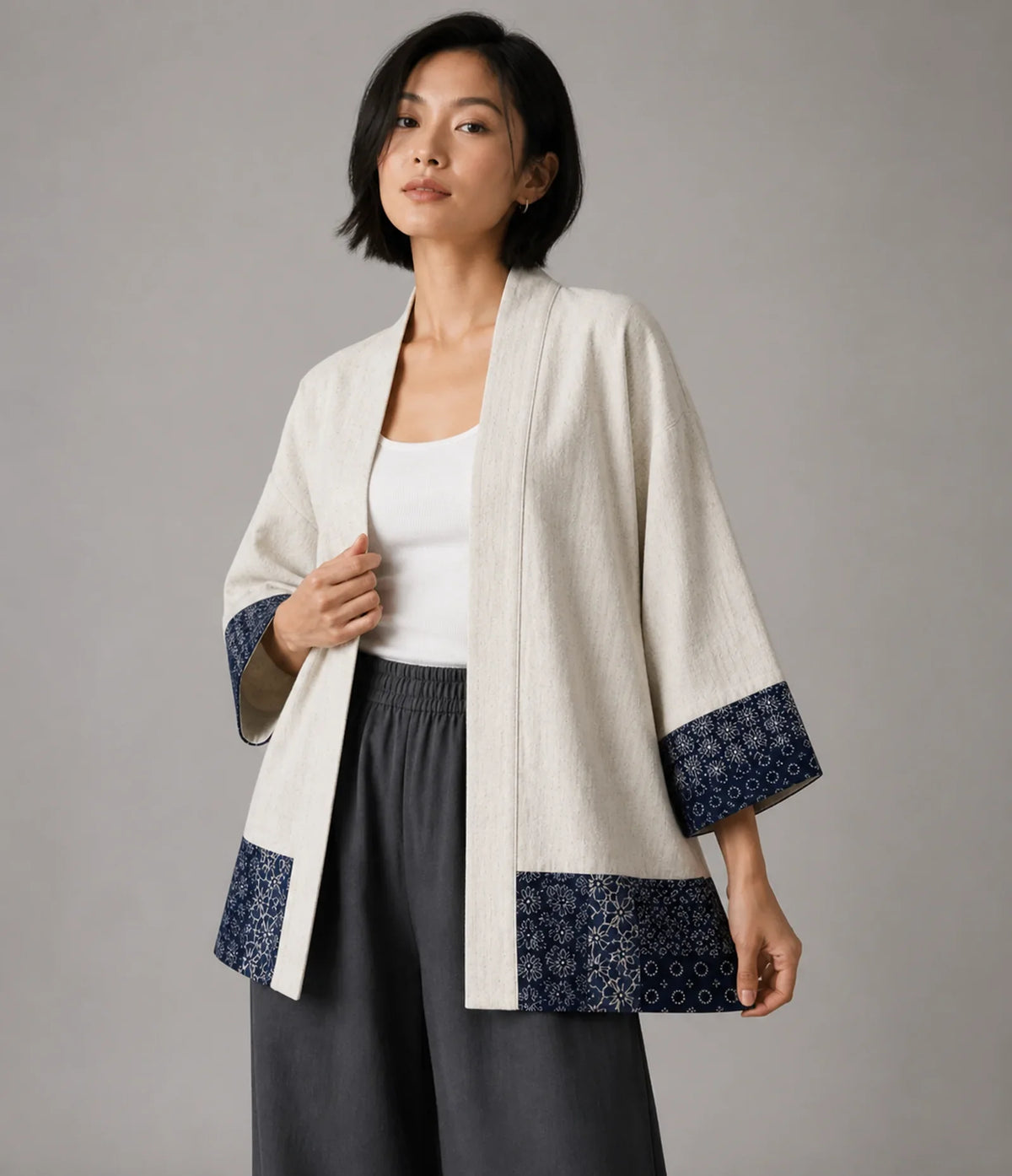
A modern haori-style jacket is often designed for Western clothing. It may have dropped shoulders, side pockets, narrower sleeves, a different hem length, or a fabric that behaves more like denim or canvas.
When shopping for a traditional haori, give particular attention to:
- Center-back-to-cuff reach
- Body and back width
- Sleeve depth and opening
- Compatibility with the kimono underneath
- Measurements of the individual garment, especially if it is vintage
When shopping for a modern haori-style jacket, focus on:
- Flat chest or body width
- Shoulder width
- Shoulder-to-cuff or center-back-to-cuff measurement
- Garment length
- Hem width
- Layering room
Do not use a kimono length rule to choose a haori. A haori is a jacket; its hem position is largely a matter of design and intended use.
What Does “One Size” Mean?
“One size” means one garment size is offered. It does not mean the jacket will fit every wearer in the same way.
A loose, open front makes the body width more flexible, but sleeve reach, shoulder proportions, armholes, and hem length remain fixed.
If a one-size jacket looks promising, check the actual measurements and compare them with your reference garment. Model height can provide a visual clue about length, but it cannot replace the size chart.
What If the Product Page Is Missing a Measurement?
Do not guess if the missing number affects your decision.
Ask the seller:
- Where is chest or body width measured?
- Is sleeve length measured from the shoulder or center back?
- What is the jacket length’s starting point?
- How wide is the jacket near the hem?
- What is the sleeve opening or upper-arm width?
- Does the listed size describe the finished garment or a recommended body size?
On a Seapoom product page, use that item’s own size guide rather than assuming another haori-style jacket has identical proportions. Fabric and design can change the fit even when two products share a size label.
Before You Order: A Five-Minute Fit Check
Lay out your reference jacket and write down these numbers:
- Flat body width
- Shoulder width, if applicable
- Jacket length
- Sleeve reach and its measurement method
- Hem width, if relevant
Then put on the reference jacket over your intended base layer. Note anything you would change: perhaps more room at the back, a shorter cuff, or a longer hem.
Compare those preferences with the product’s diagram and measurements. If one number uses a different measuring method, clarify it before ordering.
A short measurement check is usually more useful than trying to translate a familiar Western size directly into a haori size.
Final Thoughts
A haori should hang easily, allow natural movement, and finish at a sleeve and hem length you are comfortable wearing. The most reliable way to find that fit is to compare actual garment measurements with a jacket that already works for you.
Pay particular attention to how sleeve reach is defined. Traditional yuki runs from the center back toward the cuff; modern sleeve length may start at the shoulder seam. Body width also needs a clear diagram, especially on an open-front jacket.
When the measurements are taken from the same points, you can make an informed choice without relying on vague labels such as “oversized” or “one size.”
Frequently Asked Questions
Is yuki the same as sleeve length?
Not always. Yuki measures from the center back of the neck across the shoulder to the sleeve opening. A modern jacket’s sleeve length may be measured only from the shoulder seam to the cuff. Check the seller’s measuring diagram before comparing the numbers.
Does a one-size haori fit everyone?
No. An open front allows some flexibility through the torso, but the jacket still has fixed shoulders, armholes, sleeve reach, and length. Compare its garment measurements with a jacket you already wear comfortably.
Should I size up to wear a sweater under a haori-style jacket?
Possibly, but check more than chest width. You need room through the back, armholes, and sleeves as well. Try your reference jacket over a sweater, then compare its measurements with the haori-style jacket you are considering.

Leave a comment
This site is protected by hCaptcha and the hCaptcha Privacy Policy and Terms of Service apply.