

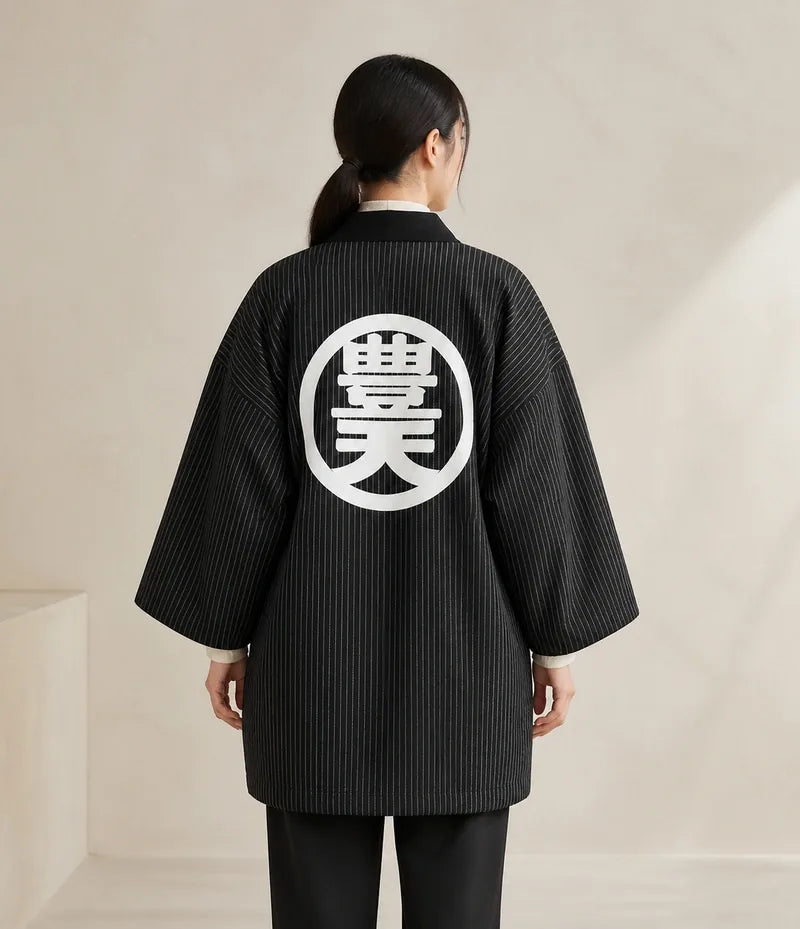
A haori is traditionally an outer jacket worn over kimono, but its straight shape and open front also work naturally with modern clothing. It can add texture and a relaxed silhouette to an outfit without requiring traditional accessories or formal dressing knowledge.
The easiest approach is to treat a contemporary haori or haori-style jacket as an unstructured outer layer. Wear it in the place of a cardigan, overshirt, light chore jacket, or casual blazer while allowing its wider sleeves and cleaner front to remain visible.
A haori does not need an elaborate outfit underneath. In many cases, a plain shirt, comfortable trousers, and simple shoes provide the best foundation.
Begin with a Simple Base
If you are wearing a haori for the first time, begin with clothing you already use regularly.
A reliable base might include:
- A plain T-shirt and jeans
- A button-down shirt and straight trousers
- A simple dress
- A knit top and wide-leg pants
- A tank top and long skirt
- A sweatshirt and relaxed trousers
Simple clothing allows you to judge the haori’s proportions without competing patterns or accessories.
The base does not need to be entirely neutral, but its colors should relate to the jacket. A navy haori, for example, can work with white, gray, beige, faded denim, olive, or muted blue.
Wear the Haori Open
A haori is generally designed to hang open or connect lightly at the front with small cords. It is not normally wrapped tightly across the body like a kimono or secured with a wide belt.
Leaving it open creates two vertical lines through the front of the outfit. These lines can make a wide or boxy jacket feel balanced.
Some modern haori-style jackets include front ties. Fasten them loosely if the design calls for it, but do not pull the sides together until the shoulders or neckline distort.
If the jacket has no closure, there is no need to add one.
Haori with a T-Shirt and Jeans
A plain T-shirt and jeans create one of the easiest haori outfits.
The familiar base keeps the outfit casual, while the jacket adds shape and texture.
Try these combinations:
- Black haori, white T-shirt, and blue jeans
- Indigo haori, gray T-shirt, and black jeans
- Sand haori, black T-shirt, and dark denim
- Olive haori, cream T-shirt, and faded jeans
- Patchwork haori, solid T-shirt, and simple trousers
A T-shirt with a clean neckline works particularly well because it does not compete with the haori’s front band.
Choose jeans with a straight, relaxed, tapered, or wide leg according to the jacket’s volume. Very slim jeans create stronger contrast with wide sleeves, while relaxed jeans produce a softer workwear silhouette.
Haori with a Button-Down Shirt
A button-down shirt makes the outfit slightly more polished without requiring a formal jacket.
Wear the shirt:
- Open over a T-shirt
- Buttoned with the collar relaxed
- Tucked into trousers
- Untucked beneath a shorter haori
Avoid an overly stiff collar if it pushes against the haori neckline. Softer cotton, linen, or brushed shirts usually sit more naturally underneath.
For a clean smart-casual outfit, combine a solid haori with a white or pale-blue shirt, straight dark trousers, and simple leather or canvas shoes.
Haori with Knitwear
A haori can be worn over lightweight knitwear in cool weather.
Good base layers include:
- A fine-gauge crew neck
- A simple turtleneck
- A thin cardigan
- A fitted long-sleeve knit
- A lightweight sweatshirt
Check the armholes and sleeves before adding thick knitwear. A roomy body does not guarantee enough space in the upper arms.
Avoid forcing a heavy sweater into a narrow-sleeved haori. Bunched fabric can restrict movement and distort the shoulder line.
A smooth turtleneck creates a clean background for an open jacket, especially in black, charcoal, cream, or navy.
Haori with Wide-Leg Trousers
Wide sleeves and wide-leg trousers can create a balanced outfit when the layers have different visual weights.
Keep the top underneath relatively simple and avoid excessive bulk at the waist.
A shorter haori can work well with high-waisted trousers because it keeps the leg line visible. A longer jacket creates a continuous vertical shape and may suit trousers with a softer drape.
Possible combinations include:
- Cotton haori with linen-blend trousers
- Indigo haori with charcoal wide-leg pants
- Natural patchwork jacket with cream or brown trousers
- Black haori with black trousers and a contrasting shirt
- Denim haori-style jacket with relaxed khaki pants
If both pieces are very wide and stiff, the outfit may feel heavy. Use a softer or closer-fitting base layer to provide contrast.
Haori with a Dress
A lightweight haori can add coverage and structure to a simple dress.
The jacket works especially well with:
- Solid sleeveless dresses
- Straight shirt dresses
- Simple knit dresses
- Long relaxed dresses
- Minimal slip-style dresses worn over appropriate base layers
Compare the jacket hem with the dress shape.
A short haori can visually raise the waist and preserve the line of a fuller skirt. A longer haori creates a straighter silhouette over a narrow or flowing dress.
If the dress is patterned, choose a quieter jacket. If the dress is solid, the haori can provide pattern or texture.
The jacket should sit comfortably over the dress without pulling fabric upward at the shoulders.
Haori with Skirts
Haori can be worn with long, midi, or shorter skirts depending on the jacket’s length.
A cropped or hip-length jacket pairs easily with:
- High-waisted skirts
- Pleated midi skirts
- Straight denim skirts
- Long linen skirts
- Simple A-line shapes
With a voluminous skirt, keep the top underneath relatively close to the body. With a narrow skirt, a wider jacket can provide useful contrast.
Pay attention to where the jacket hem meets the skirt. When both end at similar wide points on the body, the outfit may appear visually divided. A shorter or longer jacket may create a cleaner proportion.
Haori as Workwear-Inspired Outerwear
Cotton, denim, canvas, and patchwork haori-style jackets can be styled similarly to chore coats.
Pair them with:
- Work shirts
- Heavy T-shirts
- Straight jeans
- Utility trousers
- Relaxed chinos
- Boots or sturdy sneakers
Functional pockets and textured fabric support this approach.
A workwear-inspired haori does not need additional Japanese motifs to establish its character. Its cut, fabric, and construction already provide visual interest.
Styling a Black Haori
Black is versatile, but an all-black outfit can lose detail if every fabric has the same surface.
Use texture to separate the layers:
- Black woven haori over a smooth cotton shirt
- Black patchwork jacket with plain trousers
- Black cotton-linen haori over washed denim
- Black jacket with a charcoal knit and matte footwear
For stronger contrast, add white, gray, cream, olive, rust, or faded blue underneath.
Small differences between black and charcoal can create more depth than trying to match every item perfectly.
Styling an Indigo or Navy Haori
Indigo and navy work well with many everyday colors.
Try them with:
- White
- Ecru
- Gray
- Black
- Brown
- Khaki
- Olive
- Pale blue
- Faded denim
If you wear an indigo jacket with jeans, use noticeably different shades. A dark jacket with faded jeans is easier to coordinate than two almost-matching indigo fabrics.
New dark fabric may transfer color, so be cautious with pale shirts, bags, and furniture until you understand how the garment behaves.
Styling a Sand or Natural Haori
Sand, beige, and natural cotton colors create a softer appearance.
They pair well with:
- Black
- Chocolate brown
- Navy
- Olive
- Rust
- Cream
- Muted blue
- Dark denim
A natural jacket can be combined with light clothing, but include enough contrast to keep the outfit from blending into one undefined color.
Darker shoes or trousers can provide a visual anchor.
Styling a Patterned or Patchwork Haori
Allow a patterned jacket to be the main feature.
Choose a base with:
- Few colors
- Limited graphics
- Simple shapes
- Minimal accessories
- Quiet footwear
You do not need to repeat every color in the jacket. Selecting one neutral or secondary color is usually enough to connect the outfit.
A modern patchwork appearance should not automatically be described as antique boro. Use the product’s accurate construction and material terms when discussing the garment.
Balance the Jacket Length
Haori and haori-style jackets can finish at the upper hip, lower hip, thigh, or below.
Shorter jackets
A shorter length can:
- Work with high-waisted trousers
- Keep the legs visually longer
- Feel practical while sitting
- Suit fuller skirts
- Create a compact silhouette
Longer jackets
A longer length can:
- Create vertical lines
- Add coverage
- Feel more coat-like
- Work with slim or straight base layers
- Give lightweight fabric more movement
The best length depends on your torso, hips, clothing underneath, and preferred silhouette rather than a fixed height rule.
Styling for a Petite Frame
If you are petite, focus on sleeve reach and jacket length as well as width.
A very wide jacket can still work when:
- The cuffs remain clear of the hands
- The hem finishes at an intentional point
- The base outfit has clean vertical lines
- The fabric is not excessively heavy
A shorter haori worn with high-waisted trousers or a simple dress can help keep the outfit balanced.
Monochrome or closely related colors can also reduce strong horizontal breaks.
Styling for a Tall Frame
Tall wearers may need to prioritize sleeve reach.
A jacket that fits comfortably through the body can still finish unexpectedly high on the forearms. Short sleeves may be useful, but they should be a deliberate choice.
Longer haori-style jackets can complement a tall frame, though shorter designs also work when their proportions are clearly intentional.
Use the garment measurements instead of assuming a unisex or oversized label provides sufficient length.
Styling Broad Shoulders
Dropped shoulders and wide sleeves can sit comfortably on broad frames, but armhole and upper-back room still matter.
Choose a jacket that hangs from the shoulders without pulling across the shoulder blades.
Keeping the front open creates vertical lines and avoids adding pressure across the chest.
If a heavily structured fabric makes the upper body feel wider than desired, try softer cotton or cotton-linen fabric with more drape.
Choose Shoes That Match the Outfit’s Purpose
A modern haori can work with many types of footwear.
For casual outfits:
- Minimal sneakers
- Canvas shoes
- Slip-on shoes
- Simple sandals
- Low-profile boots
For smarter outfits:
- Loafers
- Plain leather shoes
- Ankle boots
- Minimal flats
For workwear-inspired outfits:
- Leather boots
- Sturdy canvas sneakers
- Practical lace-up shoes
Traditional footwear is not required when the rest of the outfit is modern. Choose shoes that fit the setting and the clothing underneath.
Keep Accessories Deliberate
A haori already creates a distinctive silhouette. Too many accessories can make the outfit feel themed rather than natural.
Useful additions include:
- A simple watch
- A plain shoulder bag
- A compact crossbody bag
- A restrained scarf
- Minimal jewelry
- A practical tote
Wide sleeves may cover bracelets or catch on large accessories. Consider how the jacket moves before adding items around the wrists.
If the haori has decorative fabric or a detailed lining, allow that feature to provide the interest.
Wearing a Haori in Warm Weather
Choose lightweight, unlined fabric and keep the layers underneath minimal.
A haori can be useful in air-conditioned spaces or during cooler mornings and evenings. It may be removed and folded when temperatures rise.
Even an open jacket can feel warm if the fabric is dense. Check the fabric weight rather than relying only on fiber composition.
Wearing a Haori in Cool Weather
Add a long-sleeve shirt, lightweight sweater, or turtleneck underneath.
A haori is generally not a replacement for a weatherproof winter coat. In colder conditions, it can be used as an intermediate layer if its sleeves fit comfortably beneath the outer coat.
Avoid forcing wide haori sleeves into narrow coat sleeves. The fabric can bunch under the arms and restrict movement.
A cape, very roomy overcoat, or outer layer with generous sleeves may work more comfortably.
Should You Add a Belt?
A traditional haori is not normally wrapped and secured with an obi.
Belting a modern haori-inspired jacket is a fashion choice, but it changes the intended open silhouette. It may also create pulling at the shoulders or stress the fabric.
If you want to experiment with a belt:
- Use a soft jacket with enough body width
- Avoid crushing structured pockets
- Keep the belt comfortably loose
- Check that the fabric falls evenly
- Do not present the result as traditional haori dressing
Leaving the jacket open is usually the simplest and most versatile option.
Traditional Haori and Modern Haori-Style Jackets
A traditional haori is made to coordinate with kimono. Its sleeve shape, length, fabric, lining, cords, and formality belong to that clothing system.
A contemporary haori-style jacket may be designed specifically for T-shirts, dresses, jeans, or workwear. It may include pockets, denim, reversible construction, narrower sleeves, or modern sizing.
Both can be worn with contemporary clothing, but the fabric and construction influence how casual the outfit appears.
Handle vintage silk and formal haori carefully. Everyday cotton and blended jackets are usually easier to incorporate into frequently worn outfits, subject to their individual care labels.
Common Haori Styling Mistakes
Adding too many competing elements
Strong graphics, several patterns, large accessories, and statement shoes can distract from one another. Begin with one focal piece.
Ignoring sleeve volume
Wide sleeves may catch on bags, furniture, or outer coats. Make sure the outfit works during actual movement.
Forcing the front closed
A haori does not need to meet across the chest. Pulling a small jacket closed can distort the neckline and shoulders.
Choosing size only for width
An oversized body may come with sleeves or a hem that are longer than expected. Compare every measurement.
Treating the jacket as a costume
Wear the garment as part of a real outfit rather than combining unrelated cultural symbols. Accurate terminology and simple styling show more care.
Ignoring fabric behavior
Heavy denim, soft cotton, linen, and reversible fabrics do not create the same silhouette even when their measurements match.
A Simple Outfit Formula
Use this formula when you want a quick starting point:
- Choose a plain base layer.
- Add straight, relaxed, or wide-leg trousers.
- Wear the haori open.
- Select simple shoes suited to the setting.
- Add no more than one or two practical accessories.
Then adjust color and proportion according to the jacket.
When styling a Seapoom haori-style jacket, use the individual product’s fabric, length, and sleeve shape to guide the outfit instead of applying one formula to every design.
Final Thoughts
A haori can fit naturally into an everyday wardrobe because it functions as a simple outer layer. It does not require a complete traditional outfit or a collection of themed accessories.
Begin with familiar clothing, leave the jacket open, and pay attention to length, sleeve volume, fabric weight, and color balance. A plain T-shirt, comfortable trousers, and practical shoes are often enough.
The goal is not to make every outfit look traditionally Japanese. It is to let the haori’s open structure and relaxed shape contribute to clothing you can genuinely wear.
Frequently Asked Questions
Can I wear a haori with jeans?
Yes. Jeans provide a simple base for a haori or haori-style jacket. Pair a patterned jacket with plain denim, or use contrasting denim shades if the haori itself is indigo.
Should a haori be worn open or closed?
A haori is generally worn open or connected lightly with haori cords. It is not normally wrapped tightly across the body. Modern jackets with ties can be fastened according to their design, provided the shoulders and neckline do not pull.
What shoes should I wear with a modern haori outfit?
Minimal sneakers, canvas shoes, loafers, ankle boots, sandals, and simple leather shoes can all work. Choose footwear that matches the base outfit and setting; traditional Japanese footwear is not required for modern styling.

Leave a comment
This site is protected by hCaptcha and the hCaptcha Privacy Policy and Terms of Service apply.