

A Japanese-style jacket without buttons or a zipper is not necessarily missing a closure. Open fronts, connecting cords, overlapping panels, and fabric ties belong to different garment structures, and each creates a different fit.
A traditional haori normally hangs open or connects lightly with haori-himo cords. A samue jacket wraps across the body and usually uses inner and outer ties. A padded hanten may have simple front ties that bring its sides closer together without creating a complete overlap.
Understanding these differences helps you wear each garment correctly. It also makes online shopping easier because you can tell whether a jacket should close, how adjustable it is, and whether any necessary cords are included.
What Does Himo Mean?
Himo is a general Japanese word for a cord, string, or tie.
The term can describe different items depending on the garment and context. It does not refer to one universal cord used for every type of Japanese clothing.
Examples include:
- Haori-himo used at the front of a haori
- Fabric ties attached to a samue jacket
- Simple ties on a padded hanten
- Koshi-himo used during kimono dressing
- Decorative or practical cords on modern Japanese-inspired clothing
The material, length, strength, and purpose of these ties can vary significantly.
Why Closure Type Matters
A closure affects more than whether a jacket stays shut.
It influences:
- Front overlap
- Neckline shape
- Movement
- Warmth
- Layering room
- Visual balance
- Stress on the fabric
- How the garment should be sized
A tie designed only to connect two front edges should not be used to force a small jacket closed. A wrap jacket, meanwhile, needs enough body width for its panels to overlap before the ties are fastened.
Identify the closure type before judging the fit.
Open-Front Haori
A traditional haori is an outer jacket worn over kimono. Its front sides normally hang open rather than overlapping across the body.
The open construction allows the kimono and obi beneath it to remain properly arranged. It also creates two vertical lines at the front.
A modern haori-style jacket may be worn over:
- T-shirts
- Button-down shirts
- Knitwear
- Dresses
- Jeans
- Relaxed trousers
If the jacket is designed to remain open, the front edges do not need to meet across your chest.
Trying to pull them together can distort the shoulders and make a correctly sized jacket appear too small.
What Are Haori-Himo?
Haori-himo are cords used to connect the front of a haori.
They attach to small loops near the front edges and hold the two sides in relation to each other. They do not normally make one panel overlap the other like kimono.
Haori-himo can be:
- Braided
- Knotted
- Woven
- Beaded
- Simple or decorative
- Permanently attached
- Detachable
Their design may reflect the formality, color, and character of the haori.
Modern casual jackets may use simple fabric or rope-like cords inspired by this function.
How Haori-Himo Should Sit
The cords should connect the front edges without strong tension.
When properly adjusted:
- The shoulders remain in place
- The neckline does not pull
- The front edges hang naturally
- The cords do not press against the chest
- The garment remains easy to move in
If the cords are stretched tightly in a straight line, the jacket may lack sufficient room or the cords may be too short.
Haori-himo should support the shape, not reshape the entire jacket.
Does a Haori Need Haori-Himo?
Not every haori must be worn with visible cords in every modern outfit.
A traditional ensemble may call for an appropriate haori-himo. A contemporary haori-style jacket may be designed to remain completely open or may include its own closure.
Before buying, check whether:
- Attachment loops are present
- Cords are included
- The cords are removable
- The jacket is designed as a traditional or modern garment
- Product photographs show the intended front arrangement
Do not assume missing cords are a defect if the jacket has no attachment points and is intentionally open.
Replacing Missing Haori-Himo
A detachable haori-himo can often be replaced if the attachment loops are intact.
When selecting a replacement, consider:
- Cord length
- Weight
- Color
- Formality
- Attachment method
- Strength of the garment loops
A heavy decorative cord may pull on delicate vintage silk. A very short cord can place unnecessary tension on the front.
Avoid piercing the garment with improvised pins unless the item is specifically designed for them. A specialist can recommend an attachment method for valuable or delicate haori.
Samue Wrap Closures
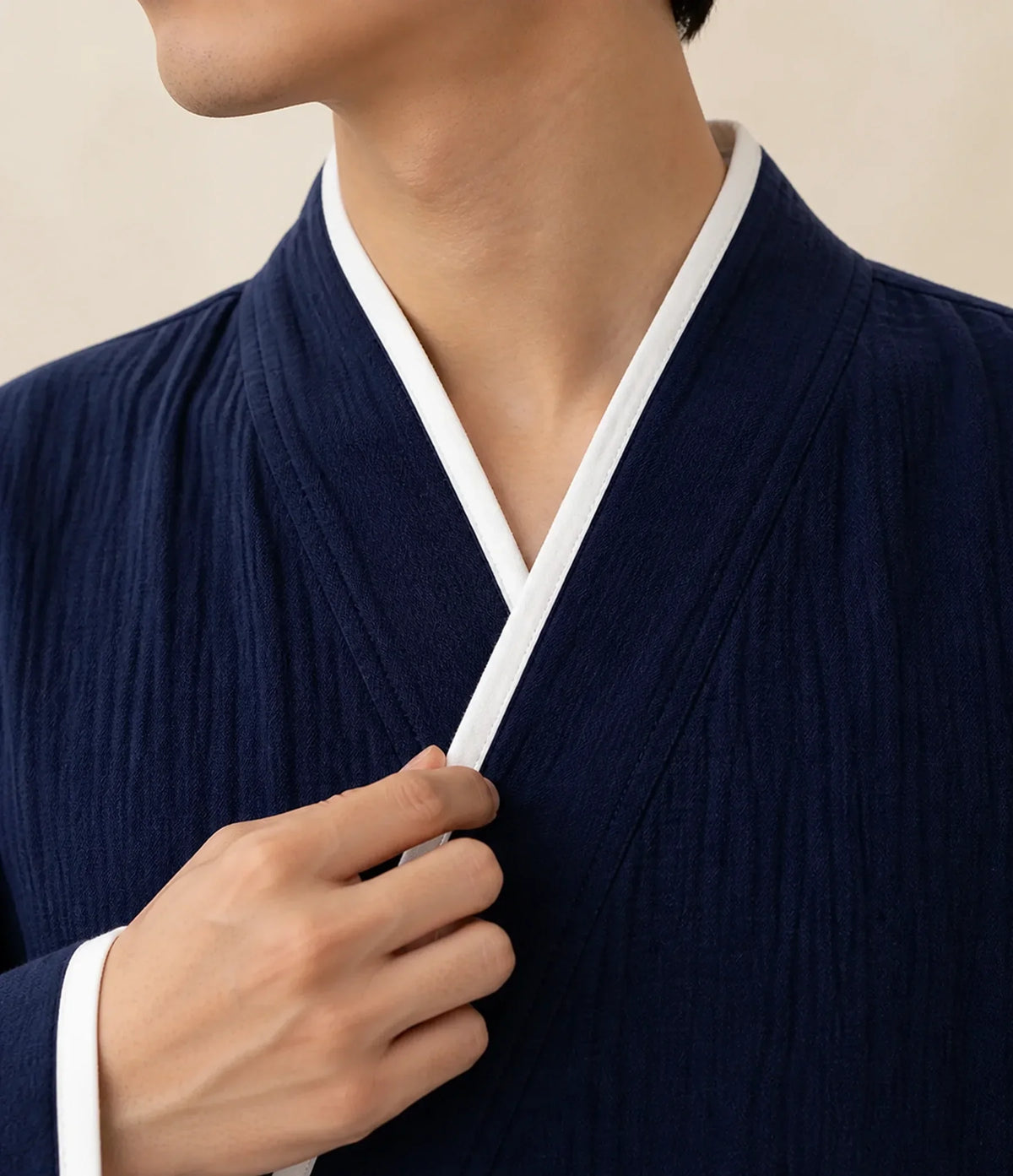
A samue jacket normally wraps across the body.
For conventional wear:
- Place the right front panel against the body.
- Bring the left front panel over the right.
- Fasten the inner tie.
- Fasten the outer tie.
- Adjust the neckline and overlap.
Unlike haori-himo, samue ties help maintain a complete wrap. The jacket therefore needs enough width for the front panels to overlap comfortably.
The ties should secure the position without pulling tightly.
Inner Samue Ties
The inner tie holds the first panel against the body.
It may be small and easy to overlook, particularly when it is made from the same fabric as the lining or seam.
Fasten it securely enough to prevent the inner panel from slipping, but do not pull it sharply across the waist.
An overtightened inner tie can:
- Create pressure against the body
- Twist the neckline
- Pull the inner panel upward
- Place stress on the seam
- Make sitting uncomfortable
After fastening it, take a normal breath and turn your torso to check comfort.
Outer Samue Ties
The outer ties keep the visible panel in position.
They may sit at the side, near the waist, or slightly above it depending on the design.
A simple bow is practical because it can be adjusted and removed easily. Avoid hard knots that become difficult to untie after movement or washing.
If the outer tie pulls the jacket into deep folds, check the overlap and size rather than continuing to tighten it.
Samue Tie Placement and Fit
Tie position affects how the jacket sits.
If the ties sit too high for your torso, the jacket may pull against the chest. If they sit too low, the neckline may open.
Because the ties are sewn into fixed positions, a larger or smaller jacket can change where they fall on the body.
When trying on a samue jacket, check that:
- The tie position feels natural
- The left panel remains over the right
- The neckline forms a comfortable V
- The front remains covered while sitting
- The upper back allows movement
- The seams around the ties remain flat
Hanten Front Ties
A padded hanten often uses a pair of simple fabric ties at the front.
These ties bring the sides closer together but may not close the entire jacket. A hanten can remain partly open at the neckline, chest, or lower front depending on its design.
Fasten the ties gently. The padding should not become strongly compressed around the torso.
If the ties barely meet, the hanten may be too small for your body or the layers underneath.
Why Hanten Ties Should Not Be Overtightened
A padded hanten retains warmth partly through its insulation and the air held within it.
Pulling the jacket tightly can:
- Compress the padding
- Reduce shoulder movement
- Distort the neckline
- Damage the tie attachment
- Create pressure while sitting
The ties position the jacket; they are not a substitute for a zipper or fitted closure.
In windy conditions, use suitable outerwear instead of pulling the hanten more tightly than intended.
Hanten Ties and Safety
Long ties and wide sleeves need attention during practical activities.
Keep them away from:
- Open flames
- Stove burners
- Rotating machinery
- Power tools
- Door handles
- Bicycle components
- Workshop equipment
Tie the cords into a compact bow and tuck away long ends when appropriate.
A hanten is warm clothing, not certified protective equipment.
Noragi-Style Jacket Closures
Noragi refers broadly to Japanese work clothing, so modern noragi-style jackets use several closure types.
These may include:
- An open front
- One pair of fabric ties
- Multiple ties
- A partial overlap
- A full wrap front
- Buttons
- Hidden snaps
A modern design may combine Japanese workwear influences with contemporary jacket construction.
Follow the garment’s actual structure instead of assuming every product labeled noragi closes the same way.
Open Noragi-Style Jackets
An open noragi-style jacket can be worn like an overshirt or light chore coat.
The front edges do not need to meet. Proper fit is determined more by:
- Upper-back movement
- Shoulder balance
- Sleeve reach
- Body width
- Hem position
Adding an improvised belt can change the intended shape and place pressure on pockets or seams.
Wrap-Front Noragi-Style Jackets
A jacket with a true wrap front should provide sufficient overlap before the ties are fastened.
For a traditional-style wrap, place the left panel over the right.
Check the overlap while:
- Standing
- Sitting
- Reaching forward
- Turning your torso
- Carrying ordinary items
If the jacket opens repeatedly, it may lack width or the ties may be positioned incorrectly for your body.
Modern Buttons and Snaps
Contemporary Japanese-inspired jackets may include buttons, snaps, hooks, or zippers.
These additions can make the garment easier to wear with Western clothing and provide more wind protection.
Use them as designed. Do not force a button closed if the fabric pulls strongly across the back or chest.
Hidden snaps should lie flat. If they create puckering, check whether the jacket is twisted or under tension.
Reversible Jacket Closures
A reversible jacket must look and function properly on both sides.
Check whether:
- Ties are finished on both faces
- Pockets are usable on both sides
- Labels remain hidden or removable
- Seams are clean
- Snaps work in both directions
- Closure points align when reversed
A bulky knot or exposed attachment may be comfortable on one side and irritating on the other.
Before washing a reversible jacket, review the care requirements of both visible fabrics.
Kimono and Koshi-Himo
Koshi-himo are long ties used during kimono dressing to hold the garment in position before the obi is completed.
They are not the same as haori-himo.
A koshi-himo normally sits beneath the finished layers and performs a structural function. It should be secure but not painfully tight.
Using a decorative haori cord in place of a dressing tie, or using a dressing tie as a visible haori closure, may not provide the intended result.
Obi Is Not a Jacket Closure
An obi secures and completes a kimono or yukata outfit. It is not normally used to close a haori worn over the top.
Placing a wide obi around a traditional haori changes the garment’s intended arrangement and may crush the fabric.
A modern designer may style a haori-inspired jacket with a belt, but this should be understood as contemporary fashion rather than standard traditional haori dressing.
Happi Coats and Belts
Happi coats are often worn open or with a separate belt or sash.
The belt may hold the sides closer to the body without creating the structured overlap of kimono.
Product designs vary, so check whether the belt is included and how the coat is intended to sit.
Do not confuse a happi belt with an obi required for formal kimono dressing.
How to Tie Flat Fabric Ties
For everyday samue, hanten, and modern jacket ties, a simple bow is usually practical.
A useful bow should:
- Lie relatively flat
- Remain secure during movement
- Be easy to untie
- Avoid excessively long loops
- Place minimal stress on the seam
If the fabric is slippery, make the bow smaller and check it periodically rather than forming a tight hard knot.
Do not pull from the middle of an attached tie. Hold near the intended tying point and apply gentle, even tension.
Do Not Double-Knot Delicate Cords
A tight double knot can be difficult to remove and may damage delicate cords.
This is particularly important for:
- Braided haori-himo
- Silk cords
- Beaded designs
- Vintage accessories
- Thin fabric ties
Use the closure method intended for the item. If you are unsure how a decorative cord fastens, examine its hooks, loops, or finished ends before tying it.
How Closures Reveal a Fit Problem
A closure can help you recognize incorrect sizing.
Possible signs include:
Strong tension at the attachment points
The garment may be too small or the layers underneath may be too thick.
Front edges twisting inward
The ties may be overtightened or positioned incorrectly.
Neckline pulling against the throat
The jacket may be pulled too far backward or closed too tightly.
Wrap opening while sitting
The garment may lack sufficient front overlap or hip room.
Shoulders sliding backward
The jacket may be too large, too heavy, or poorly balanced.
Repeatedly loosening ties
The fabric may be slippery, the bow may be unsuitable, or the ties may be under excessive tension.
Resolve the fit issue instead of using a stronger knot.
What to Check Before Buying Online
Examine the closure carefully in product photographs and descriptions.
Confirm:
- Whether the garment is open or wrap front
- Whether ties or cords are included
- Whether they are attached or removable
- Number of closure points
- Tie length and material
- Location of attachment points
- Whether replacement cords can be used
- Whether the closure works on both sides of a reversible jacket
- Whether measurements are taken open or closed
- Whether the product requires a separate belt or obi
If the model wears the jacket open, do not assume it will overlap fully when closed.
When reviewing a Seapoom jacket, use the individual product photographs and specifications to identify whether it has haori-style cords, wrap ties, hanten ties, or an intentionally open front.
Caring for Fabric Ties
Before washing, follow the garment’s care label.
When machine washing is permitted:
- Untie hard knots
- Secure long ties in a loose bow
- Use a laundry bag when appropriate
- Avoid allowing cords to wrap around other garments
- Select a gentle cycle
- Reshape ties before air drying
Do not leave a wet knot in place. The tied area may dry slowly, hold dye, or develop deep creases.
Caring for Detachable Cords
Remove detachable haori-himo before cleaning the jacket unless the instructions say otherwise.
Store the cords:
- Untangled
- Away from moisture
- Away from direct sunlight
- Without heavy objects on top
- With the haori if they form a coordinated set
Beaded or metal components may require different care from textile cords.
Inspect the Attachment Points
Tie attachment points experience repeated pulling.
Check them regularly for:
- Loose stitches
- Fraying
- Distorted loops
- Small fabric tears
- Uneven tension
- Damaged hooks
Stop pulling on a damaged point. Continued use can turn a small repair into a larger tear.
For valuable, vintage, silk, or lined garments, ask an experienced repair professional to reinforce the area.
Repairing a Loose Tie
A simple cotton tie may be repairable if the surrounding fabric remains strong.
The repair needs to distribute tension across the seam rather than placing several tight stitches in one small area.
Do not sew through a lined or reversible jacket without considering how the repair will appear on the other side.
If the fabric is torn, heavily padded, delicate, or historically valuable, professional repair is safer.
Styling Open and Closed Jackets
An open front creates vertical lines and shows the base layer.
This works well with:
- Plain T-shirts
- Simple shirts
- Knit tops
- Dresses
- Monochrome outfits
A wrap or tied front creates more shape around the torso. Keep the fabric smooth and avoid excessive folds at the waist.
Do not close every available tie simply because it is present. Some decorative cords are intended to connect lightly rather than pull the garment shut.
Common Closure Mistakes
Assuming a jacket is missing buttons
An open front may be intentional.
Pulling haori-himo too tightly
The cords connect the sides; they do not turn the haori into a wrap jacket.
Using ties to compensate for a small size
This stresses the seams and restricts movement.
Wrapping samue in the wrong direction
For conventional wear, the wearer’s left panel goes over the right.
Applying kimono rules to every jacket
Haori, hanten, happi, and modern noragi-style jackets do not all overlap in the same way.
Ignoring detachable accessories
Product photographs may show cords or belts that are sold separately. Check what is included.
Washing long ties loose
They can knot, stretch, or wrap around other clothing.
A Quick Closure Check
Before wearing the garment for an extended period, ask:
- Is this jacket intended to remain open?
- If it wraps, is the left panel over the right?
- Are all required cords included?
- Do the ties sit without strong tension?
- Can I reach and sit comfortably?
- Does the neckline remain in place?
- Are the attachment points secure?
- Are long cords safe for my activity?
This check prevents many fit and care problems.
Final Thoughts
Japanese clothing uses different closure systems because the garments serve different purposes.
A haori normally hangs open or connects lightly with haori-himo. A samue jacket uses an overlapping front with inner and outer ties. A padded hanten uses simple cords that position the jacket without creating a tight closure. Modern noragi-style and reversible jackets may adapt these systems or add buttons and snaps.
Use each closure according to its construction. Ties should support a comfortable fit, not force a garment into a shape it was not designed to hold.
Frequently Asked Questions
Is a haori supposed to close completely at the front?
No. A traditional haori normally hangs open or connects lightly with haori-himo cords. Its front sides do not need to overlap or meet like a buttoned Western jacket.
Which panel goes on top when tying a samue jacket?
The wearer’s left panel goes over the right. Place the right panel against the body first, fasten the inner tie, then bring the left panel over it and secure the outer tie.
Can missing haori-himo be replaced?
Yes, detachable haori-himo can often be replaced when the garment’s attachment loops are intact. Choose cords with an appropriate length, weight, color, and attachment method, and avoid placing heavy cords on delicate fabric.

Leave a comment
This site is protected by hCaptcha and the hCaptcha Privacy Policy and Terms of Service apply.